
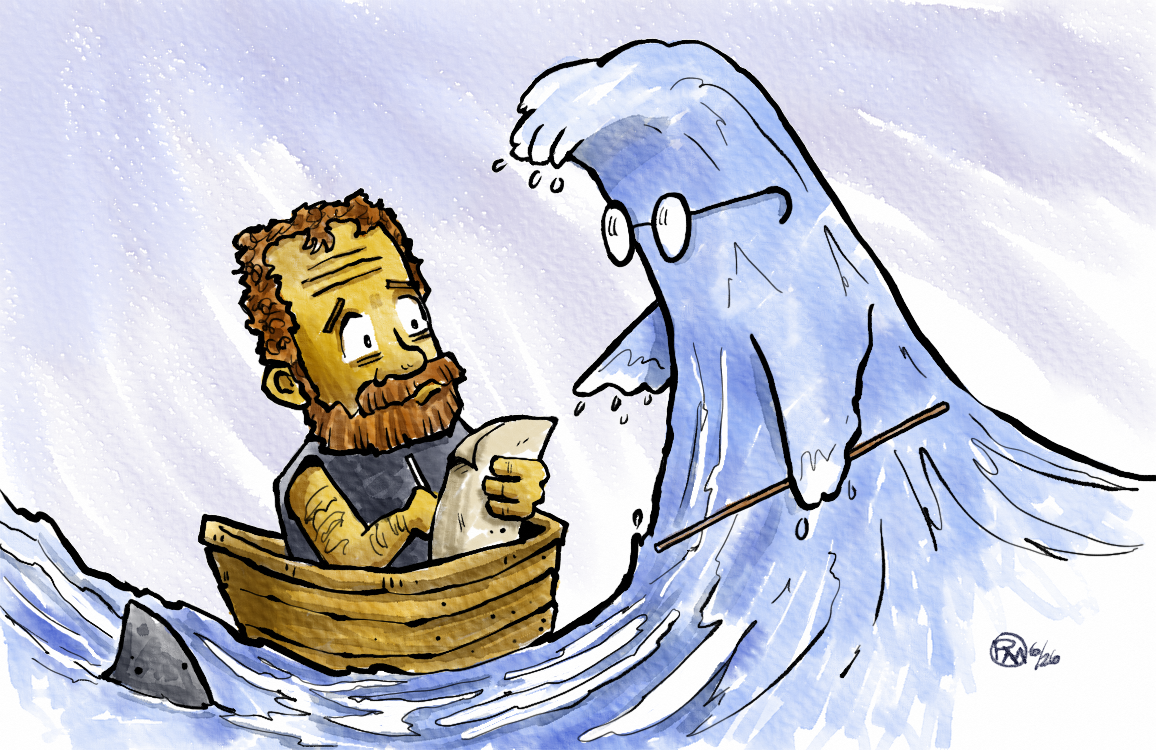
There comes a point in every sailor’s life when the ocean quits handing out quizzes and decides it’s time for the final exam.
This was ours.
The boat rolled and pitched uneasily at anchor while the wind moaned through the rigging like it already knew the answers and wasn’t about to share them. Out beyond the reef, the pass we’d have to navigate looked less like an entrance and more like a giant flushing toilet. White water exploded across the opening. Every few minutes a larger breaker would rear up and crash down with enough force to remind us that Mother Nature wasn’t impressed by our plans.
And just to make things interesting, a nasty storm was bearing down on us. If we got out, we’d be sailing straight into it for the next 750 miles.
As far as I was concerned, this was the final exam of offshore sailing.
Young Luke and I climbed into the dinghy and headed back toward the pass for one last look. The ride itself was enough to make you question your life choices. The little inflatable launched off waves, crashed into troughs, and took enough spray over the bow to keep us thoroughly soaked.
When we reached the pass, things looked no better than before.
The current was absolutely screaming through there—seven, maybe eight knots pouring outward. Huge breakers rolled across the entrance. Inside were coral heads scattered around like underwater land mines. The wind was already building and would be blowing forty-five to fifty knots directly across our beam if we tried to enter.
In other words, perfect conditions for staying in a nice hotel somewhere.
We ran around to the south side of the island looking for alternatives. No luck. Fifteen-foot seas from the southeast were detonating against the reef over there. Anchoring would be like tying yourself to a railroad track and hoping the train changed direction.
Back aboard, we held what could generously be called a strategy meeting.
Our choices looked something like this:
Option One: Stay where we were, get blown onto the reef, and die.
Option Two: Drive through a thirty-foot-wide hole in the reef against a seven- to eight-knot current, through breaking surf, with shallow coral waiting inside and forty-knot winds trying to shove us sideways into oblivion… and maybe die.
Option Three: Anchor on the south side, hide from one storm, get smashed by another, and die.
Option Four: Head offshore into a full gale for several days and spend every minute wishing we were dead.
As you can see, we had plenty of choices.
Being sailors, naturally we picked Door Number Two.
Jody had come up with an idea. We tied some dive-belt weights onto a line and marked it at nine feet. Luke and I bounced back out to the pass and spent another hour taking soundings, threading our way between coral heads, and trying to convince ourselves this wasn’t completely insane.
Eventually we reached the point every cruising sailor knows well: when you’ve gathered all the information you’re going to get and now you simply have to make a decision.
The pass looked barely possible.
Not safe.
Not smart.
Just possible.
So we went for it.
Back aboard, I gathered the crew and calmly explained what everyone should do if we hit the reef.
Notice I said “if,” not “whether.”
Then I swallowed two Xanax.
Said a prayer—the first sincere one I’d offered up in years.
And we hauled anchor.
As if on cue, a black squall appeared on the horizon.
Of course it did.
The ocean has a twisted sense of humor.
By then there was no turning back.
I brought the engine up and tested her limits. Beating into the wind and chop, I could squeeze about eight knots out of her. That was important because the current ripping through that pass was almost matching it.
Joel climbed into the spreaders for a better view. Luke stationed himself on the bow pulpit. Jody got the video camera ready because if we survived this, nobody back home was going to believe it.
And me?
I was behind the wheel trying not to think about all the things that could go wrong.
The entrance rushed toward us.
Or maybe we rushed toward it.
It’s hard to tell when your pulse is somewhere north of 180.
The moment we committed, the current grabbed the bow and swung it sideways like King Kong swatting a toy boat. One second we were lined up perfectly; the next we were pointed somewhere completely different.
I spun the wheel hard over and fought to regain control.
Ahead of us, breakers exploded across what suddenly looked like an impossibly narrow opening.
A wave lifted us.
Another broke directly ahead.
For a split second I wondered if we were about to surf sideways onto the reef.
But somehow we punched through.
The engine roared.
The boat shuddered.
And we entered the pass.
Even with the engine pushing nearly eight knots, it felt like we were standing still.
The current was that strong.
The water boiled around us. Coral flashed beneath the surface on both sides. In places it looked like there were only six or eight feet separating us from disaster.
I kept spinning the wheel like a madman.
At one point I realized I was whistling the theme song from Gilligan’s Island.
Stress does strange things to people.
The pass narrowed.
The wind shoved us relentlessly toward starboard.
Closer.
Closer.
Soon we were only a few feet from the reef.
The current continued pouring outward at nearly seven and a half knots. Looking over the side, it seemed like you could crawl faster than we were moving.
Nobody spoke.
Nobody needed to.
The wind was howling too loudly anyway.
Luke pointed.
Joel signaled.
Jody relayed messages from one end of the boat to the other.
We threaded between coral heads that looked close enough to touch.
Time stretched.
Minutes felt like hours.
And then, suddenly, it was over.
The current eased.
The water flattened.
The depth sounder climbed.
One moment we were fighting for our lives in a narrow slot of raging water, and the next we were gliding across the calm turquoise lagoon.
I looked back over my shoulder.
From inside, the pass looked impossibly small.
Maybe twelve feet wide.
I laughed.
Partly from relief.
Partly because I knew eventually we’d have to get back out.
That would be a problem for another day.
We motored across the lagoon and dropped anchor in a sheltered spot just as the first real signs of the storm began to arrive.
Within an hour local divers came out to greet us.
Mopelia.
One of those rare places that still feels like the world did before someone invented schedules, deadlines, and television.
The people farmed black pearls and fished the surrounding waters. Communication was interesting. They spoke a local Polynesian dialect and very little French. We spoke English and even less Polynesian.
Fortunately, smiles and hand gestures are an international language.
Before long Luke and Joel were off diving with the locals.
The storm arrived exactly as forecast.
And trapped us there.
Not that anyone was complaining.
Over the next five days we completely fell in love with the island.
The handful of families scattered among the motus adopted us like long-lost relatives. They took us fishing. They showed us where to find lobster. They taught us how to harvest heart of palm for salads.
Every day felt like stepping backward in time.
Breakfast might be tern eggs collected from nearby bird islands.
Lunch could be fresh fish speared that morning.
Dinner was often lobster cooked over an open fire with coconuts gathered a few hours earlier.
The beaches stretched for miles, untouched and brilliant white. The lagoon glowed every impossible shade of blue imaginable. Outside the reef, giant storm waves exploded in endless plumes of white spray while inside everything remained peaceful and calm.
We wandered through palm groves, explored deserted motus, and visited tiny bird islands crowded with thousands upon thousands of nesting terns.
At night we’d sit beneath a sky so full of stars it looked almost fake.
No cities.
No roads.
No noise.
Just the ocean breathing against the reef.
We were 260 miles from Papeete.
More than 1,200 miles from Tonga.
About as far from civilization as most people ever get.
And we wouldn’t have traded places with anyone on earth.
Funny thing about sailing.
Sometimes your greatest adventures begin when every available option appears to end with disaster.
And sometimes the scariest pass you’ve ever entered leads straight into paradise.


We had a moment like that trying to sneak between two storms in Dixon Entrance, crossing from Ketchikan to Prince Rupert. We time it wrong, and soon we were taking water over the bow that sloshed all the way back to the dodger. When my wife pointed out we were making zero progress, just a blob of dots on the plotter, we turned and started surfing back the way we came.
My timing was off — the dinghy we were towing (Pro Tip: never tow in open water or rough weather!) flipped, but fortunately it acted as a drogue that kept our speed down to 10-11 kts…until the painter parted. Somewhere there’s a fisherman with a shiny new inflatable gift from the gods.
When we got to Dundas Isl. we darted up into a crack that runs deep up the middle of the island, and found a half-dozen boats with more sense had already taken shelter there. We spent the next few days drying out, drinking wine and playing Scrabble in one of the prettiest hidey-holes we had ever found, and would never have seen if not for necessity.