

Every once in a while, something happens in life that seems so insignificant at the time you barely give it a second thought. Then, years later, sometimes decades later, you look back and realize that little incident may have had more influence on your life than you ever imagined.
Funny how that works. Sometimes the biggest lessons in life don’t come from some great philosopher, a motivational speaker, or a guy standing on a stage telling you how to become successful. Sometimes they come from a conversation on a dock, while you’re holding a hose and trying not to wash your neighbor’s dinghy into the next county.
I remember one such incident quite clearly. It happened a little over thirty years ago.
At the time, I was living aboard my Formosa 51, which was tied to a mooring in King Harbor, Redondo Beach, California. I’d been on a waiting list for a slip, and getting one had become something of a personal obsession. I wanted electricity, a telephone, and the convenience of being able to step off the boat without first performing a balancing act worthy of a circus acrobat.
Remember, this was before inexpensive cell phones. Back then, having a telephone aboard was a big deal. You actually had to be somewhere to answer it. Imagine that! No carrying a little electronic leash around in your pocket, no checking messages while sitting in a dinghy, and no one being able to find you unless they knew where you were.
It was practically paradise.
Eventually, my name came up on the waiting list, and I got a slip on Y Dock. I moved in, plugged into shore power, connected the telephone, and settled into what I thought was the good life.
Of course, anybody who has ever owned a boat knows that getting a slip doesn’t mean you’ve arrived at some magical destination where everything is wonderful. It just means you’ve found a permanent place to discover new things that need fixing.
But I was happy.
One afternoon, I was washing down the boat when my neighbor showed up. He had a beautiful 43-foot Endeavour and had been living aboard for several years. He was one of those guys who was always talking about going cruising.
You know the type.
He’d talk about Mexico, the South Pacific, tropical islands, and all the wonderful places he was going to visit someday. He had the boat, the money, and apparently the desire. The only problem was that his wife wasn’t particularly interested in spending the next few years bouncing around the ocean.
That can put a little damper on the cruising plans.
This particular afternoon, however, he seemed especially down. I walked over, and we started talking about the usual marina stuff. Boats, weather, maintenance, and the endless list of things that seem to occupy the minds of people who have voluntarily chosen to live in a fiberglass bathtub.
Then he dropped the bomb.
His wife had asked for a divorce, and he was being forced to sell his business.
Well, that opened the floodgates.
Before long, I was getting the complete financial and emotional history of his life. He’d built a very successful software company, and thirty years ago, that was a pretty good business to be in. He’d worked hard, built the company, and eventually sold it for a substantial amount of money.
Then came the divorce.
His wife received half the proceeds, and after that, the tax man arrived to collect his share. Apparently, Uncle Sam wasn’t particularly interested in hearing about his marital problems.
He was looking at a tax bill of more than a million dollars.
We stood there on the dock for a while, listening to him explain how unfair it all was. He was going to lose so much money. His life was falling apart. Nothing was going right.
I listened for a while, trying to be sympathetic. But eventually, I just couldn’t keep my big mouth shut.
There was a lull in the conversation, and I asked him how much he’d actually sold the company for.
He told me.
It was a seven-figure deal.
Now, I’m no financial wizard. In fact, if you want to see someone become confused, just hand me a complicated tax form. But even I could do the math on this one.
I looked at him, then looked around the marina.
And suddenly it hit me.
“Okay, let me see if I have this straight,” I said. “You’ve got more than a million dollars left, a beautiful 43-foot boat, and you live in one of the nicest harbors in Southern California. You’re standing here in the sunshine, surrounded by sailboats, looking out at the Pacific Ocean, and you’re complaining about paying taxes?”
He looked at me.
I continued.
“Where the hell else would you rather be? How many people in this world would give just about anything to be standing exactly where you’re standing right now?”
Then I shut up.
Well, mostly.
The silence that followed was pretty impressive. I wasn’t sure whether he’d decided I was an idiot or whether he was actually considering what I’d said.
Finally, he looked around the harbor.
“You know,” he said, “you’ve got a point.”
He paused for a moment.
“I’ve been working all my life. I’ve spent so much time building the business and worrying about making money that I’ve never really stopped to look at what I’ve accomplished. I’m sixty years old. I’ve got a great boat, enough money to live on for the rest of my life, and I’m standing here feeling sorry for myself.”
We both went quiet.
Outside the harbor, sailboats that had been racing in the afternoon breeze were beginning to make their way back toward the marina. The sun was warm, the water was sparkling, and the boats were coming through the entrance one by one.
It was one of those beautiful Southern California afternoons when you wonder why anybody would want to live anywhere else.
After a while, he looked at me again.
“You know, I’ve always wanted to go cruising,” he said. “I think I’m going to give it a try.”
I smiled.
“Well, it’s about damn time.”
And that was pretty much the end of the conversation.
Three years later, he returned to King Harbor.
But he wasn’t the same guy who’d stood beside me on the dock complaining about his taxes.
He’d taken his Endeavour down the Pacific coast of Mexico, transited the Panama Canal, and sailed through the Caribbean. He’d visited places he’d spent years talking about and finally discovered what it was like to actually go cruising instead of just talking about it.
And while he was in Venezuela, he’d met a beautiful woman.
She ended up sailing with him all the way back to the States, and before long, they were married.
Not a bad outcome for a guy who’d been standing on a dock three years earlier convinced his life was over.
I never forgot that conversation.
It taught me something about human nature that I’ve seen repeated over and over again in the cruising community.
We spend an awful lot of time concentrating on the things we don’t have, and very little time appreciating the things we do.
We complain about the price of fuel, the cost of marina slips, the price of provisions, the cost of boat insurance, and the fact that the refrigerator has decided to quit working just before a long weekend.
We complain about the weather when it’s too hot, too cold, too windy, or not windy enough. We complain about the anchorage being crowded, the water being too shallow, and the guy next door running his generator at six in the morning.
And if we can’t find anything else to complain about, we can always find something wrong with the boat.
That’s one thing you can count on. Boats are remarkably good at providing material for complaints.
But sometimes we need to step back and look at the big picture.
How many people would love to trade places with us?
Think about it. While somebody is sitting in rush-hour traffic, staring at the bumper of the car in front of them, you’re sitting in your cockpit watching the sun come up over a tropical island.
While somebody is getting dressed in a suit and heading off to a job they hate, you’re deciding whether to go snorkeling, explore a village, or just sit in the cockpit with another cup of coffee.
While somebody is looking at vacation pictures on a computer, you’re looking at the real thing through your companionway.
Sure, cruising has its problems. Sometimes the engine won’t start. Sometimes the wind doesn’t cooperate. Sometimes the dinghy leaks, the watermaker quits, and the holding tank decides to announce its displeasure with the world.
And sometimes, just when you think you’ve got everything under control, something breaks that you didn’t even know existed.
But that’s cruising.
We didn’t choose this lifestyle because it was easy. We chose it because it offered something that was missing from our previous lives.
Freedom.
The freedom to go where we want, when we want, and live life on our own terms. At least that’s the theory. In reality, the weather, the tides, customs officials, and occasionally a broken alternator get a vote.
But it’s still a pretty good deal.
And there’s another thing I’ve noticed. The older I get, the more I realize that happiness has very little to do with how much money you have or how many possessions you’ve accumulated.
It has a lot more to do with how you look at what you already have.
I’ve met people with millions of dollars who were miserable, and I’ve met cruisers with boats held together by duct tape, bailing wire, and a generous application of marine sealant who were happier than anybody I’d ever met.
I’ve had dinner aboard million-dollar yachts where everyone seemed to be worried about something, and I’ve shared a can of beans in a little anchorage with people who thought they’d just won the lottery.
The difference wasn’t the boat.
It was the attitude.
That’s not to say money doesn’t matter. Anybody who tells you money doesn’t matter has probably never had to replace a diesel engine, buy a new set of sails, or pay a boatyard bill. Money matters. But it isn’t the same thing as happiness.
And worrying about what you don’t have can keep you from enjoying what you do.
In today’s world, it’s pretty easy to lose sight of the good things in life. Turn on the television and you’ll be convinced that everything is going to hell. Open a newspaper and you’ll find enough bad news to make you want to crawl back into your bunk and pull the covers over your head.
The economy goes up and down. Politicians argue. Wars start. Markets collapse. Prices rise. The world seems to have a never-ending supply of reasons to be miserable.
But through all of that, one thing remains.
Hope.
Hope is what keeps us moving forward. It’s what makes us believe that tomorrow might be better than today. It’s what makes someone buy a boat, learn to sail, and start planning a voyage to places they’ve only seen on a chart.
And if you’re reading this magazine, chances are you have some of that hope tucked away somewhere.
Maybe you’re still dreaming about buying your first boat and sailing off into the sunset. Maybe you’re working toward that day when you can finally quit the job, cast off the lines, and see what lies beyond the next horizon.
Or maybe you’ve already done it.
Maybe you’re sitting in some beautiful anchorage right now, reading this while the sun goes down and the water gently rocks your boat.
If that’s the case, take a minute and look around.
Really look.
Look at the water. Look at the boats. Look at the shore. Think about where you are and how many people would love to be in your position.
You might discover that you’re already living the dream you once thought was impossible.
And if things aren’t going so well right now, remember that circumstances can change. Boats get repaired. Money comes and goes. Relationships begin and end. Plans fall apart, and sometimes something better comes along when you least expect it.
My neighbor on Y Dock thought his life was over. Three years later, he’d sailed thousands of miles, seen some incredible places, and found a new partner to share the adventure.
All because he finally stopped looking at what he’d lost and started looking at what he still had.
As for me, that afternoon on Y Dock changed the way I looked at my own life.
At the time, I owed a whole lot of money on my boat. I had boat payments, slip fees, maintenance bills, and all the other expenses that come with owning a floating hole in the water into which you pour money.
I complained about the price of the slip. I complained about the cost of repairs. I complained about all the things that weren’t quite right.
But standing there on that dock, I suddenly realized something.
I HAD A BOAT!
I lived in a beautiful harbor, in Southern California, with the Pacific Ocean just outside the entrance. I could go sailing whenever I wanted. I could untie the lines and head for the horizon.
And I was complaining about the slip fees?
What the hell was wrong with me?
Sometimes we need someone to give us a little kick in the backside to remind us how lucky we really are. Sometimes that reminder comes from a friend. Sometimes it comes from a stranger. And sometimes it comes from looking at your own life through somebody else’s eyes.
So the next time life starts getting you down, stop for a minute.
Take a deep breath. Look around. Count your blessings. And remember why you started this whole adventure in the first place.
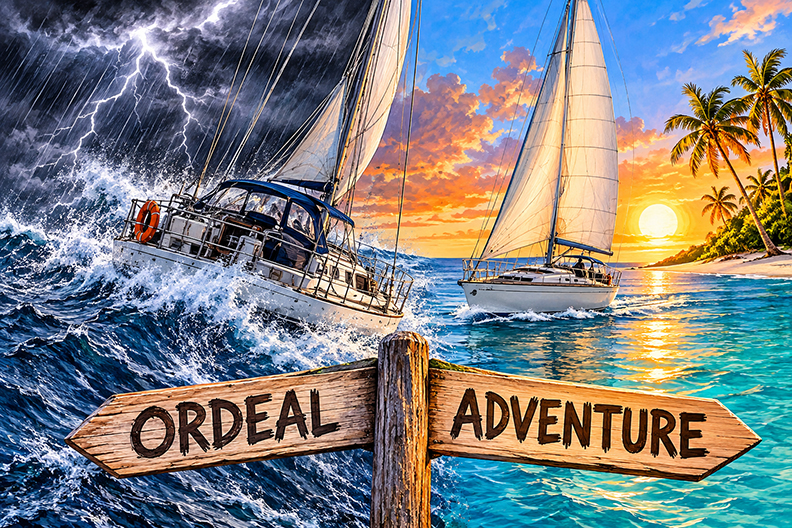
Because there’s a big difference between an ordeal and an adventure.
An ordeal is what happens when you spend all your time worrying about what might go wrong.
An adventure is what happens when you look at the same situation, smile, and decide to enjoy the ride.
The wind might be blowing harder than you’d like. The engine might be making a funny noise. The refrigerator might have quit, and the guy in the next slip might still be running his generator at six in the morning.
But you’re out there.
You’re living the life you chose.
And that’s something worth celebrating.
So stop sniveling, look around, and enjoy the damn adventure.
After all, attitude really is the difference between an ordeal and an adventure!