

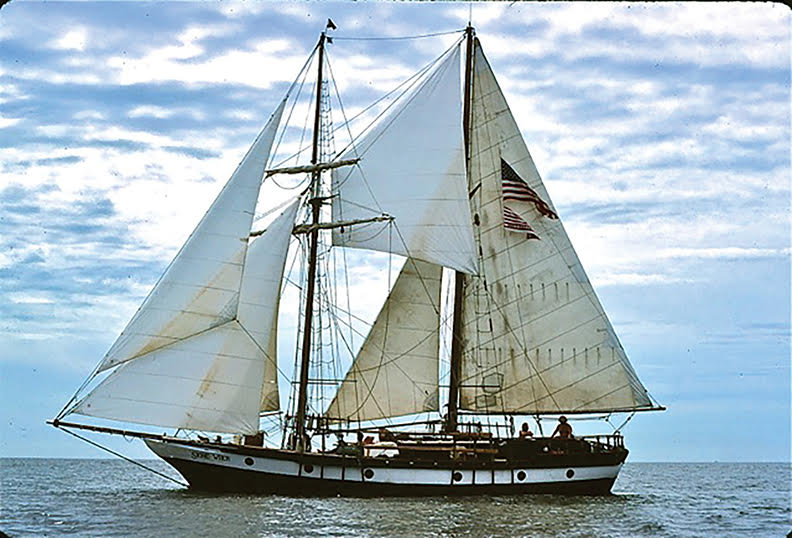
The Stone Witch held a 180 course until the end of day. Alan pulled out the charts and was showing us where we were and then explained how he figured it out. This was my first lesson in navigation and it has stood me well over the last 35 years and 100,000 sea miles.
All you need to know is how fast you are going, how long you were going that fast and on what course. It seemed like a way too simplified way to navigate to me, but when we made our right angle towards Cabo, Alan said we were about 150 miles off. At the speed we were making that meant about another day and a half. It was now the afternoon.
I was starting to see why Alan had made such a big deal about keeping our log. After every watch, every two hours, whoever was coming off watch would have to enter the course held, the estimated speed (we had no knot meter, or any other electronics for that matter) and notes on the weather, sea state, and a short note. The notes got to be funny. Looking back at a ship’s log can take you back to the day you made the entry. I find I still love reading old logs from trips and crossings I made.
On the morning of the third day we were passing Cabo Falso and sailing past a beautiful beach just around the famous rocks of the point at Cabo San Lucas. We sailed to the beach to anchor.
We arrived just about the time Alan had said. Back in the day there was no marina in Cabo San Lucas. All cruising boats anchored on the beach. There was a river that came out there, but only the smaller pangas or dinghies could go up it. Cruisers usually landed right on the beach and then walked up to the village.
Anchoring on the beach was no simple matter. The beach dropped off very fast. It was steep and deep. The only way to anchor safely there was to drop about 150 feet of chain with a good heavy anchor on the end (Stone Witch used a 150 lb. Danforth if I remember correctly) and then back up to the beach. Now that would be fairly easy for a boat with a motor, but here, once again, we got to watch a true master at work.
As we approached the beach we were under main and headsail only. When we were about 200 yards off Alan had us drop the main. We were doing about 2 knots. We had a couple of sweeps out just in case, but as it turned out, we never needed them. We then dropped the headsail. When we were about 100 feet off the beach he hollered to drop 150 feet of chain and he pushed the tiller hard a-port. The boat rounded up like a trained seal and when we came to rest, the stern was about 10 feet off the beach. “Toss the stern hook,” he ordered, and a small (about 35 lb. Danforth) with 10 feet of chain and about 100 feet of 3/4” line was heaved over the stern. One of the crew jumped into the dinghy and took it ashore, dragging the anchor about 30 feet up the beach, and pushed it into the soft white sand.
I had done a little traveling prior to this. I’d ridden a Harley across Europe and all over the U.S., but I was not aware of the rules when you arrive by boat. Alan quickly explained that only the skipper should go ashore, and he would take all the passports, crew lists and ship’s documents to the Harbor Master. Then he’d have to go see Aduana (Customs) and Imigra (Immigration).
Now you gotta remember, this was 40 years ago and in the ‘70s Cabo San Lucas was a very small and sleepy village. There were no paved roads and to make a phone call you had to walk up to the phone company. They would tell you a time to come back and then they would dial the number and guide you to a phone booth when the call was ready. Sometimes it would take a day or two.
As we sat on Stone Witch waiting for Alan to return, I saw a bunch of kids run over to the dinghy he’d left on shore. They jumped in it and started to push it into the water. I freaked! “Hey!” I shouted. “Get out of that boat, that’s ours!”
Woody grabbed my arm. “Settle down,” he said. “They are just going to play with it. They’ll put it back when they are thru.” And sure enough, they laughed and played, jumping into the boat and diving off of it, and when they were thru they pushed it back up on the beach, cleaned it out, and went on their way down the beach again.
Being an Ugly American I had figured they were stealing it. He explained that here, where people don’t have much, whatever is laying around is fair game to use or play with. And they would always return it.
A lesson learned.
Alan returned after a little over an hour and it was time for “shore leave.” We checked the anchor to make sure we were good, and we all headed for shore for the first stop on our way to Guaramala!


The good old days… great story Bob!