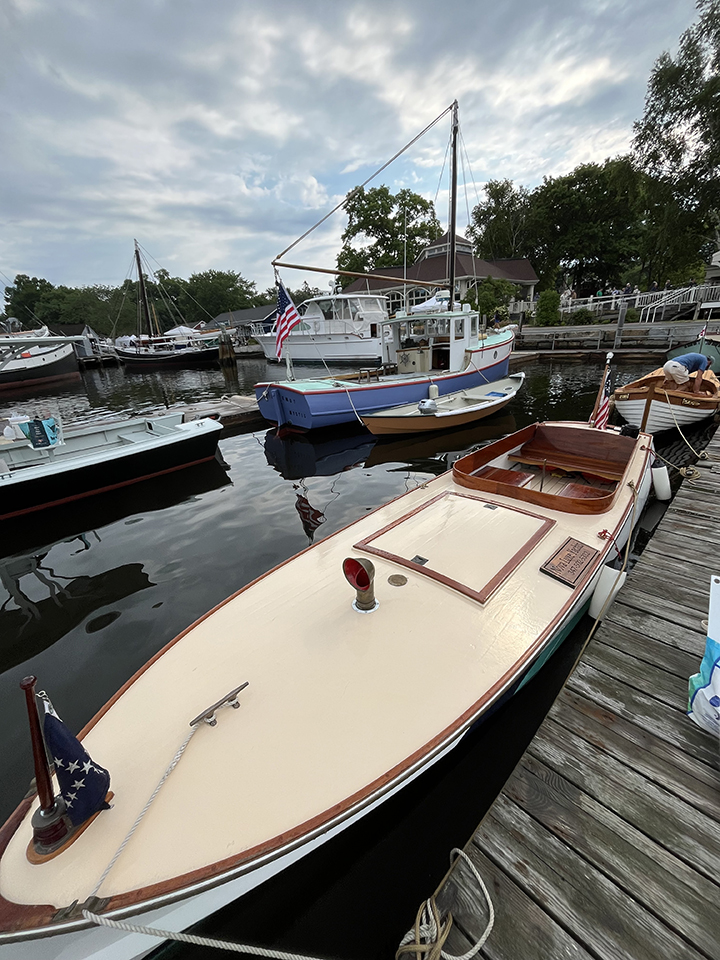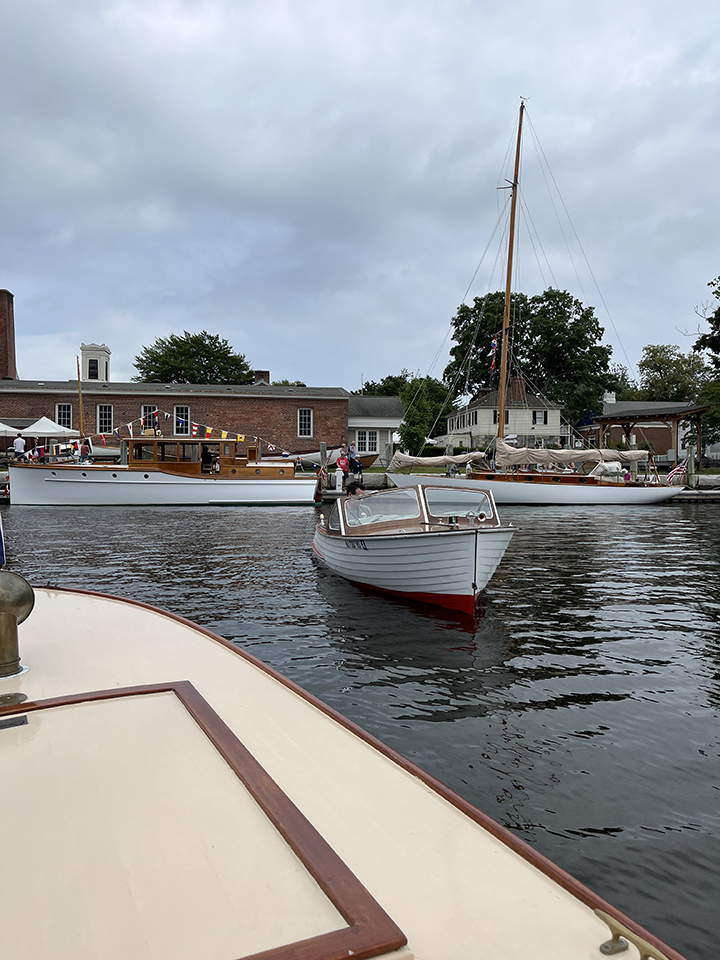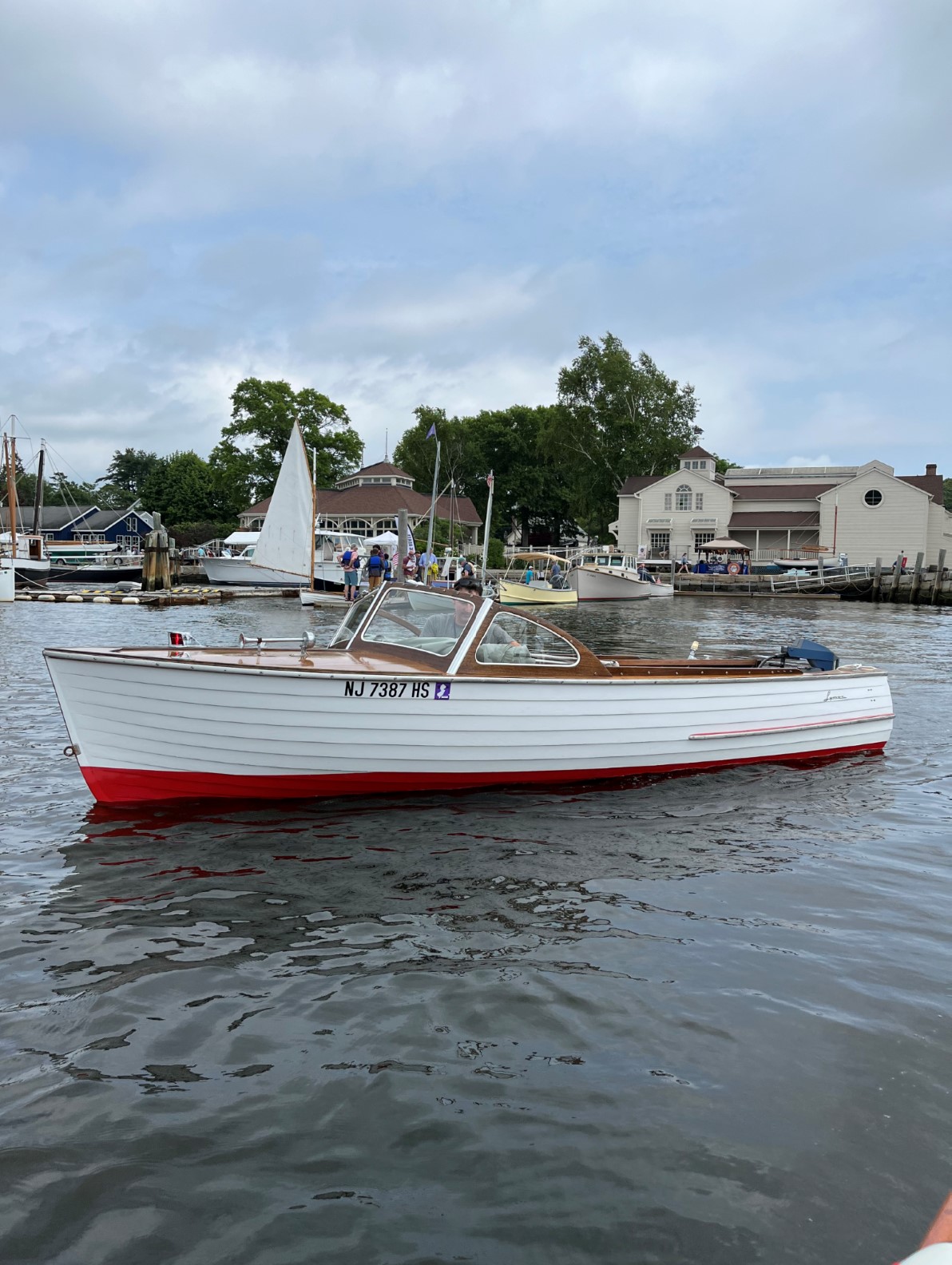

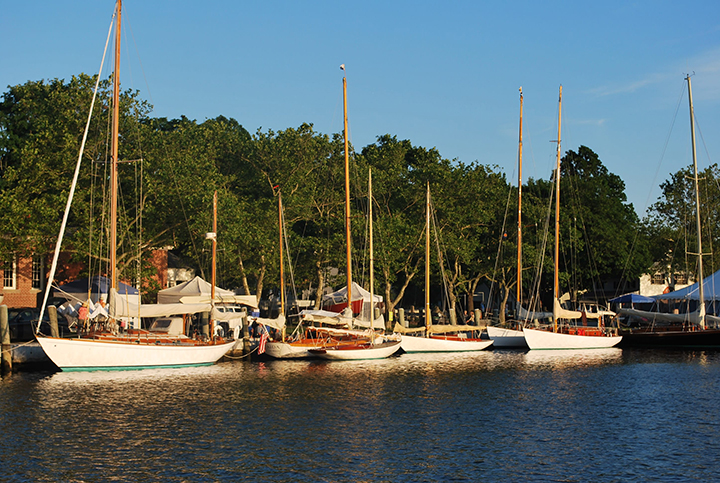
There are boat shows, and then there is the Mystic WoodenBoat Show in Mystic, Connecticut. It is less an exhibition than a pilgrimage—a gathering place where history is not displayed behind glass but continues to live, breathe, and float.
Hosted at Mystic Seaport Museum, the show takes place in what feels like a shipbuilding village preserved from another century. Rather than polished convention halls filled with fiberglass production boats, visitors wander through weathered workshops where every building serves a purpose. One shop cuts and stitches sails. Another bends and shapes steam-heated oak frames. In another, blacksmiths forge iron hardware much as they did generations ago.
At the heart of it all sits an aging hit-and-miss engine, slowly chugging away as it powers an intricate network of belts and pulleys overhead. One engine drives dozens of machines, just as it would have a century ago. It is noisy, mechanical, and wonderfully alive—a reminder that craftsmanship once depended more on ingenuity than electricity.
Outside, enormous live oak timbers lie patiently waiting for their next purpose. Their naturally curved shapes, impossible to replicate with straight lumber, make them invaluable for restoring historic vessels. Some will become frames for one of the earliest 100-foot-plus powerboats ever built. The original boat was constructed in only seven months—a remarkable feat for its time. Today, restoring that same vessel will take well over seven years, a testament not only to the complexity of preservation but to the care taken to ensure every piece honors the original builders.
For many people, Mystic is more than a destination. It is Mecca.
Visitors travel hundreds, sometimes thousands, of miles to attend. Many have followed a dream that began years earlier with nothing more than a set of drawings in WoodenBoat magazine. What started as a lines plan, a parts list, a lofting diagram, or a carved half-model slowly became an obsession. Nights in the garage turned into weekends in the shop. Weekends became years.
Building a wooden boat is rarely a practical decision. It is a labor of patience, persistence, and love. There are no shortcuts. Every plank must be shaped, every joint fitted, every mistake corrected by hand. Many builders dedicate a decade or more to a single project before it ever touches the water.
Walking through the show, you quickly notice a common thread among the crowd. Many have silver hair and weathered hands that seem permanently stained with varnish, epoxy, and sawdust. They move slowly, stopping often—not because they’re in a hurry to see everything, but because every boat sparks another story.
Most own several boats. One is ready to sail. Another is halfway restored. A third has been waiting for “next winter” for the past ten years. Nearly everyone has one boat they regret selling.
One gentleman laughed as he looked over a 1928 Herreshoff launch I was displaying.
“My wife says I’ll die and leave her with a half-finished boat,” he joked. “She’s probably right. I just hope it isn’t the one I’m working on now.”
That kind of humor is common among wooden boat owners because there’s truth behind it. Wooden boats are never truly finished. They simply reach a point where you can sail them before beginning the next round of maintenance.
Another visitor stopped to chat.
“I was supposed to bring my little launch this year,” he said. “For the last seven years I’ve had a boat in the show. This year it wasn’t ready. I decided not to rush it and just come enjoy everyone else’s work instead. Honestly, I’ve seen more of the show this year than I ever did while tending my own exhibit.”
That may be the real magic of Mystic. It’s not about competition. It’s about community. Builders admire one another’s work because they understand exactly what went into it. Every flawless plank represents countless hours of trial and error that only another builder can truly appreciate.
One story has stayed with me ever since.
The previous year, my booth was beside a modest sixteen-foot cabin cruiser. It wasn’t built by a professional shipwright but by an engineer from Ohio. One day he stumbled across a boat design and decided he would build it himself.
Years later, he loaded the finished boat onto a trailer and drove all the way from Ohio to Mystic just to be part of the show.
When the judges announced he had won Best Amateur Built Boat, the grown man stood speechless before tears filled his eyes. Years of evenings, weekends, frustrations, and victories had been recognized by people who understood exactly what he had accomplished.
Afterward, someone asked whether he had any regrets.
He smiled.
“I wish I’d built a bigger boat,” he said. “I had no idea I was going to spend this much time on it anyway.”
Every builder nearby laughed because they’d all had the same thought.
Wooden boats possess personalities unlike any other vessel. They demand attention, reward patience, and occasionally test your sanity.
After spending the winter out of the water, the planks dry and shrink. In early spring, some boats develop seams wide enough to see daylight through the hull. Launching one isn’t simply a matter of backing down the ramp.
You coax her back into the water.
She leaks at first—sometimes dramatically. Bilge pumps work overtime while the wood slowly absorbs moisture and begins to swell. Over the course of several days the seams tighten, the hull takes its shape once again, and eventually the leaks stop. Only then is she ready for another season.
Ask a seasoned wooden boat owner how to deal with a leaky hull and you’ll get a dozen different answers.
“Throw some sawdust in the bilge.”
“Rub beeswax into the seam.”
“Use a toilet wax ring from the hardware store.”
“Soak burlap bags against the hull before launching.”
Whether every trick works is almost beside the point. These remedies have been handed down through generations, each accompanied by a story that is just as valuable as the advice itself.
That is what makes Mystic special.
It is a place where knowledge is shared freely across generations. Master shipwrights talk with first-time builders. Retired engineers swap ideas with high school apprentices. Visitors arrive expecting to see beautiful boats but leave with stories, friendships, and inspiration.
The Mystic WoodenBoat Show isn’t simply about preserving wooden boats. It’s about preserving the people, skills, and traditions that built them. Every carefully fitted plank, every hand-forged bolt, every perfectly varnished transom carries with it the knowledge of those who came before.
In a world increasingly built for speed and convenience, Mystic reminds us that some things are still worth doing slowly.
Because wooden boats are never just boats.
They are years of evenings in the workshop. They are friendships formed over shared mistakes. They are family histories written in cedar, oak, bronze, and canvas. They are proof that patience can still create something beautiful.
And for one weekend each year in Mystic, that tradition is very much alive.