

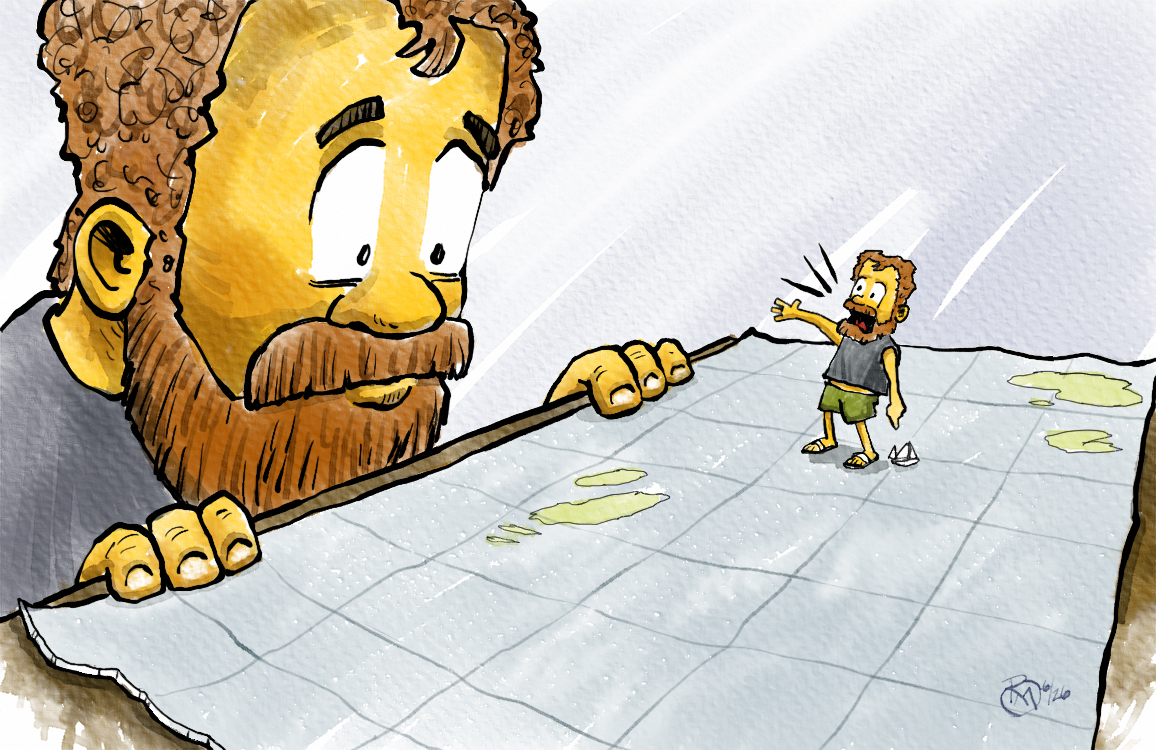
Land was only four or five miles ahead of me.
It had to be.
The fact that I couldn’t see a blessed thing out there didn’t change the mathematics of the situation. According to every calculation I’d made, every noon sight I’d taken, every line I’d drawn on the chart, the Big Island of Hawaii was right in front of us.
It simply had to be.
The problem was that nobody else on board knew I was having doubts.
And as captain, I wasn’t exactly eager to share them.
After all, the other four people aboard were counting on me. If I announced that I wasn’t entirely sure where we were in the middle of the Pacific Ocean, there was a good chance they’d become nervous.
About as nervous as I was.
We had departed Cabo San Lucas eighteen days earlier on what had been, up until that moment, the greatest adventure of my life. The crossing was everything I had dreamed it would be. The farther we got from land, the happier I became. The winds steadied, the weather warmed, the stars grew brighter, and all the clutter and noise of civilization disappeared over the horizon.
For me, it was heaven.
My crew was an eclectic collection of souls. There was my eighteen-year-old girlfriend—remember, I was single back then, so nobody get excited—and her best friend from Minnesota. There was Bruce, a bodybuilder who worked at a gym I owned and looked capable of bench-pressing the boat if circumstances required it. And there was a recent graduate from the University of Colorado Law School who, I suspect, had not envisioned spending his first weeks after graduation drifting around the Pacific with a captain who occasionally misplaced entire islands.
We navigated the old-fashioned way.
No GPS.
No chartplotter.
No electronic wizardry.
Just a sextant, sight reduction tables, dead reckoning, and whatever intelligence God had seen fit to provide me.
About halfway across the Pacific, we encountered a supertanker named Bass Pike. Through an exchange on the radio, they very politely informed me that our position appeared to be roughly eight hundred miles from where I thought it was.
Eight hundred miles.
In navigation terms, that’s not a rounding error.
That’s a completely different zip code.
After a lengthy period of denial, followed by an even lengthier period of checking my calculations, I discovered the problem.
I had been adding declination when I should have been subtracting it.
Every day the error compounded itself. Like a snowball rolling downhill, except this snowball happened to be made entirely of my own stupidity.
This was before GPS became commonplace. Satellite navigation units existed, but they cost around two thousand dollars, which at the time might as well have been two million. So celestial navigation was not a hobby. It was the only game in town.
Once I corrected the error and established a reliable position, my confidence returned.
After all, getting to Hawaii was supposed to be simple.
The old sailors had a saying:
“Sail south until the butter melts. Then turn west until you hear the ukuleles.”
It sounded foolproof.
Naturally, that’s when nature decided to intervene.
About one hundred and fifty miles from Hawaii, we were greeted by a Kona storm that came charging out of the southwest like it had a personal grudge against us.
For two days we endured winds between forty-five and fifty-five knots directly on the nose.
The sea turned ugly.
The boat pounded.
The spray flew.
The wind howled.
And we were blown nearly one hundred miles backward.
To add insult to injury, we tore out the toe rail.
Sailing has a wonderful way of reminding you that the ocean doesn’t care about your plans.
Eventually the storm passed.
The winds moderated.
The skies cleared.
And we resumed our approach toward the Big Island.
Which brings us back to that particular day.
According to every calculation, every bearing, every scrap of information available to me, we were only a few miles offshore.
Now consider this.
Mauna Loa and Mauna Kea rise over twelve thousand feet above sea level. These aren’t subtle geographic features. They are not easy to overlook.
Missing them should have been about as difficult as missing a circus elephant standing in your living room.
Yet there was nothing.
No mountain.
No coastline.
No indication whatsoever that land existed.
Up to this point I had stubbornly insisted on navigating like my ancestors. I carried a radio direction finder onboard, but I hadn’t wanted to use it. I wanted the satisfaction of making landfall using nothing but the sun, the stars, and a little bit of skill.
But after studying the chart and reflecting on the enormous size of the Pacific Ocean versus the microscopic size of Hawaii, I decided pride was becoming a luxury I could no longer afford.
I pulled out the RDF.
First I found a station in Waikiki.
Then one in Hilo.
I plotted the bearings.
The lines crossed almost exactly where I had already placed our position.
According to both celestial navigation and radio navigation, we were precisely where we were supposed to be.
Which raised an uncomfortable question.
Where in blazes was Hawaii?
At that point I concluded there was only one remaining explanation.
I had somehow managed to lose an island.
A large island.
An island famous for containing volcanoes taller than many mountain ranges.
I stared at the chart and thought about the name painted on the stern of my vessel.
Lost Soul.
At the time, it seemed less like a boat name and more like a diagnosis.
I climbed on deck feeling about as low as a snake’s belly in a wagon rut.
The crew gathered around me.
They looked at me with complete confidence.
The way puppies look at their owner.
The way children look at their parents.
The way people look at someone they assume knows what he’s doing.
I was trying to formulate a speech explaining that our captain was apparently incapable of locating Hawaii when I heard an engine in the distance.
I looked up.
What I saw made absolutely no sense.
There, in the middle of my existential crisis, was an old Chris-Craft speedboat towing a stunning blonde woman on water skis.
This is not generally considered a common sight for sailors who believe they may be lost at sea.
I waved frantically.
The boat altered course and made a pass alongside us.
“HEY!” I shouted.
“WHERE’S HILO?”
The skipper continued past us, made a wide turn, and came back around.
As he drew abeam, he pointed directly ahead.
“‘Bout two miles that way, Brah!”
The crew erupted in cheers.
I stood there speechless.
Two miles?
Two miles?
How could we possibly be two miles from shore and not see land?
I sent the girls to the bow.
Bruce climbed halfway up the mast to the spreaders.
A moment later we all saw it simultaneously.
White breakers.
A strip of beach.
The faint outline of shoreline.
Less than a mile away.
Suddenly everything made sense.
The depth sounder showed five hundred feet.
We could hear the surf.
The smell of land drifted across the water.
And after eighteen days at sea, we had completed our first ocean crossing.
Only later did we learn what had happened.
Kilauea Volcano had erupted that year—1983—and the volcanic haze had created an atmospheric condition that drastically reduced visibility. On a perfectly clear day, visibility could shrink to less than half a mile.
The island had been there the whole time.
We simply couldn’t see it.
Now, what does any of this have to do with an editorial?
Not much.
At least not directly.
But the experience taught me something I’ve never forgotten.
Life is often a lot like that approach to Hawaii.
We spend an enormous amount of time worrying about where we are, where we’re headed, whether we’ve made mistakes, whether we’ve drifted off course, whether we’ve somehow managed to lose an entire island.
Sometimes we have.
Most times we haven’t.
The destination is still there, even when we can’t see it.
And eventually, if we keep moving, keep checking our bearings, and refuse to quit, the breakers appear, the shoreline emerges from the haze, and we realize we were a lot closer than we thought.
My old friend Glenn Stewart used to say:
“No matter where you go, there you are.”
Simple words.
But after crossing two thousand miles of ocean only to discover Hawaii hiding less than a mile away in volcanic haze, I’ve come to believe he was exactly right.


Great read Bob. Thanks Man!