
Ua-Pou. Say it slow and it tastes like salt and history. It’s only about 26 miles from Nuku Hiva, but it might as well be a century and a lifetime away. Five jagged spires claw up into the clouds like the bones of some old god, and one of them never quite lets go of its misty blanket. The whole island is small, green, and wild in that untouched, don’t-even-think-about-it way. Half the size of Catalina Island, but it feels ten times bigger once you step into it.
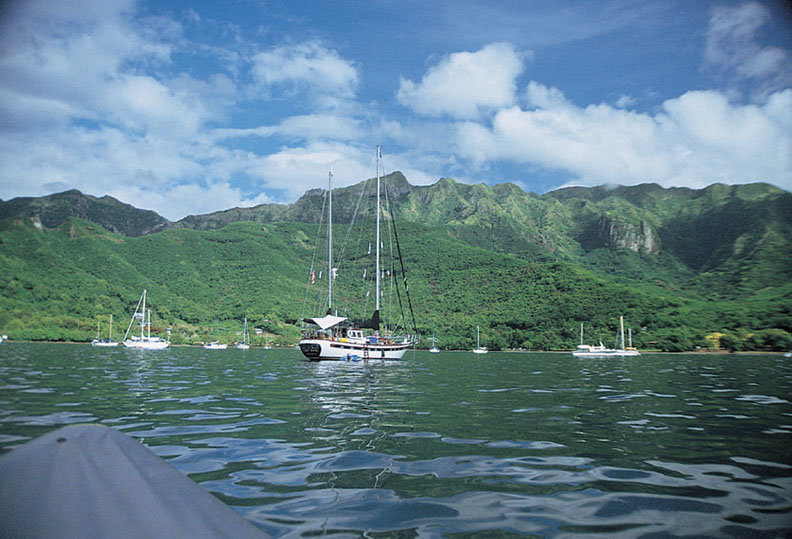
We dropped the hook in a tiny bay. Only boat there. That kind of silence where you hear your own thoughts creak.
Ashore, we found a village of maybe 50 souls. Met an old Marquesan who waved us up to his place like we were long-lost cousins. Next thing you know, we’re surrounded by family… daughter, son, grandson, in-law, and one extra guy who might’ve just wandered in and never left. Didn’t matter. They handed us bananas and these monsters called pamplemousses. Think grapefruit that hit the gym, found religion, and came back sweeter. Green on the outside, magic on the inside.
That night we turned them into drinks. Next morning, breakfast. Unreal.
They don’t speak English. Not French either. Just Marquesan, which flows like poetry but lands somewhere between a riddle and a shrug.
Then came one of those days.
You know the kind. Starts innocent. Ends with you questioning your life choices and your wiring.
We left Ua-Pou at dawn, aiming for Hiva Oa. Sixty-five miles. Easy day, right?
Wrong.
Wind on the nose. Twenty-five knots of “not today, sailor.” We started grinding into it when the bilge alarm screamed. Water where water shouldn’t be. So now we’re playing electrician in a bouncing metal box, swapping switches while the ocean tries to rearrange our bones.
Then squalls roll in. Big ones. We call them Neil winds, because blaming a friend feels better than blaming the universe. Eventually we just laugh and strip down, using the sky as a freshwater shower.
It almost worked out. Almost.
Then the wind shifts again, because of course it does. Engine overheats. Fan belt gone. We’d boiled the engine dry faster than a cheap kettle on high. So back into the engine room, which feels like sticking your head inside a volcano’s armpit.
By then, daylight’s gone.
And there’s one rule I don’t like breaking. Not ever.
Don’t enter an unknown harbor at night.
We broke it.
The bay was called Hanamenu. Narrow. Dark. Rain falling like the sky had a grudge. Spotlight flickering like it was thinking about quitting. I steered half blind, trusting radar and gut instinct. Toss in a squall and it felt about as comfortable as bad news at a family dinner.
But we made it.
Dropped anchor. Cooked filet mignon like kings who’d just survived a mutiny. Then sat there laughing like idiots, because sometimes that’s the only response left in the tank.
Morning made it all look friendly again. Funny how that works.
Quick stop at Hiva Oa. Crowded. Dirty. Not our scene. So we slipped over to Tahuata and found what postcards wish they looked like.
Empty beaches. Coconut palms leaning like they’d had a long day. Water so clear it felt like cheating.
Then came the crabs.
Coconut crabs, big and ugly and apparently worth bleeding for. John and Neil went hunting at sunset, which turned out to be terrible timing. Neil speared his own foot getting ashore. That should’ve been the hint.
Then the no-see-ums showed up.
Tiny bugs. Invisible assassins. Their bites swell up like you’ve been personally insulted by nature. John looked like he’d lost a fight with a swarm of angry freckles. Hundreds of bites. The rest of us weren’t far behind.
And the crabs? After all that blood and drama, they had about as much meat as a rumor.
We moved on.
Next stop looked like paradise had decided to show off. Crystal water, rainforest-covered mountains, the whole dreamy package. But rainforest means rain, and it didn’t stop. Not once. Everything soaked. Crew cranky. Spirits damp.
Then we reached Fatu Hiva.
And just like that, the world hit reset.
A valley straight out of a dream. Towering spires, birds circling, jungle glowing green against deep blue water. We dropped anchor mid-afternoon, still buzzing from the view.
After dark, three outrigger canoes slid up beside us like ghosts. Six young guys climbed aboard with guitars and these wild Marquesan mandolins. No English. No problem. They played and sang all night.
Every one of them tattooed. Felt like home.
At one point I filmed them, then invited them below to watch. Didn’t think twice about it.
First time they’d ever seen a TV.
When one of them realized he was looking at himself… chaos. Laughter, shouting, pointing. Pure joy. The kind you can’t fake or bottle.
That night sticks with you.
We got adopted after that.
They hung out every day. Smoked our cigarettes, devoured snacks, laughed at everything. We shared what we had. They shared what mattered.
They showed us waterfalls. Brought fruit. Fish. Stories without words.
We helped patch up a bad foot, gave rope for their outriggers, handed out perfume and small comforts from a different world. They gave us something better.
Connection.
By the end, they were there from sunrise to whenever we kicked them off so we could sleep.
And when we finally left, heading toward the Tuamotu Archipelago, it wasn’t just another departure.
It felt like slipping away from a place that had quietly claimed a piece of us.
That’s the thing about these islands.
You think you’re just passing through.
Turns out, they’re the ones doing the keeping.


What a beaitifully written article, thank you! You captured cruising and put it on paper like few can.
sounds like a dream or a wonderful movie