

Why Your Yoga Practice Is Your Best Sailing Prep.
Let’s be honest: nobody boards a boat thinking, “I sure hope my abs are ready for this.” And yet — every time you brace against a heel, hoist a sail, or catch yourself before an unscheduled meeting with the cockpit floor, your core is the thing saving you from an embarrassing story at the next dock party.
Core strength isn’t about a six-pack (mine went into hiding sometime during my extensive research into dockside happy hours :). It’s about the deep stabilizing muscles — the ones that keep you upright when the boat has other plans. A strong core protects your lower back, improves your balance on a moving deck, and honestly just makes daily boat life less exhausting. Reaching, twisting, hauling, climbing — it’s all core.
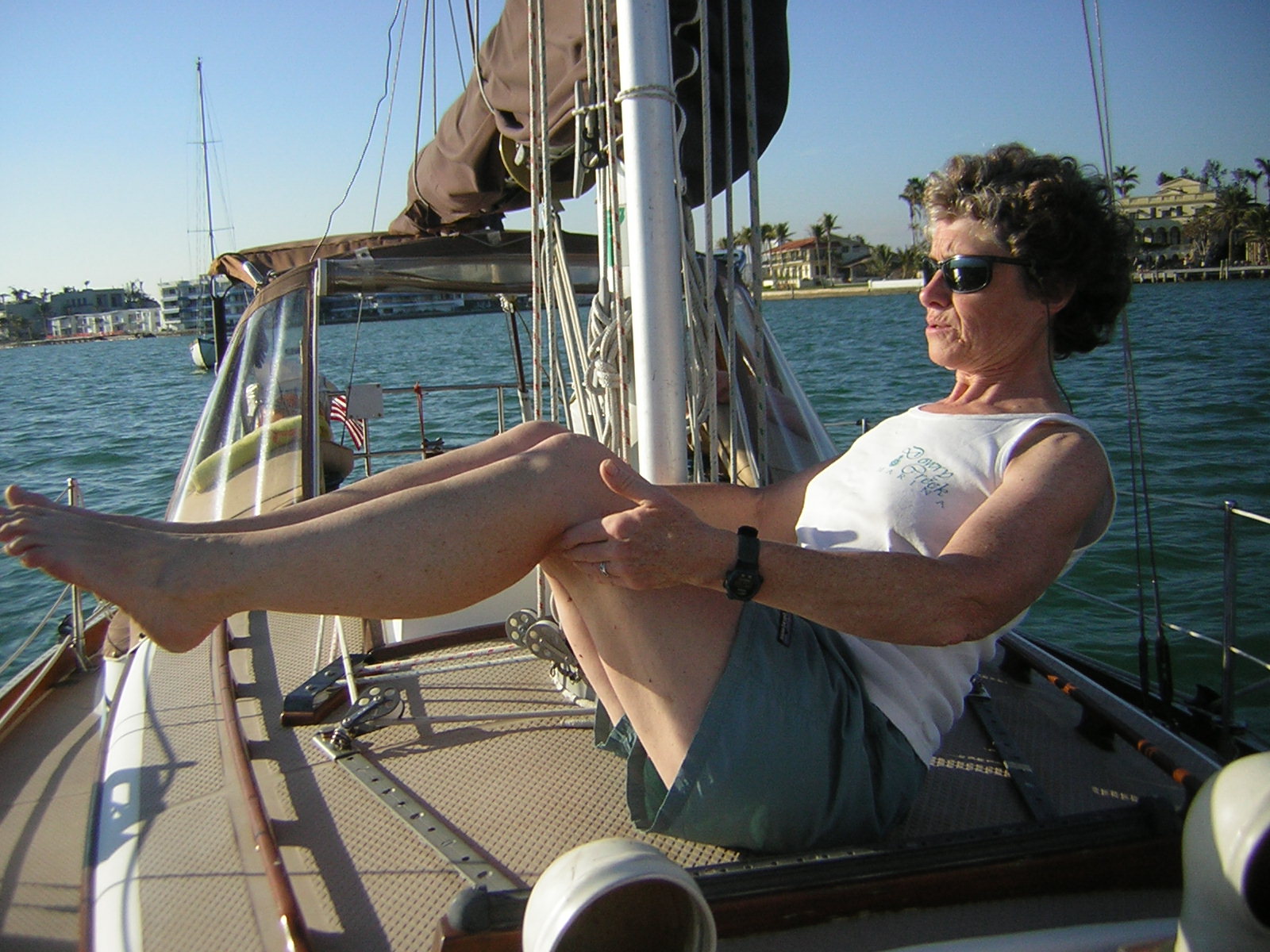
Boat Pose (Navasana) — with movement
This one’s my favorite for sailors, because life on a boat is never static, so why should your boat pose be? Here’s the variation I teach:
Sit with knees bent, feet flat, sitting up as tall as you can, keeping space between the pubic bone and rib cage-lifting the heart center; lean back slightly until you feel your core switch on. Depending on your core strength, lift one or both feet up -if one at a time, remember to switch. Instead of holding a rigid V-shape, keep it dynamic:
- Support yourself with fingertips lightly touching the deck beside your hips, or behind your knees if you need more help.
- Slowly draw your knees in toward your forehead, rounding through your spine.
- Extend back out with control — no flopping, no momentum, just slow, intentional movement.
- Repeat for 8–10 rounds, breathing steadily.
The slowness is the whole point. This isn’t a crunch race. It’s about control under sway — exactly the skill you need when the boat is doing the moving for you. For fun, you can add a twist here as well. Twist, extend, repeat on other side.
Plank Pose (Phalakasana)
Classic for a reason. Shoulders over wrists or elbows, body in one long line, tailbone neither dropped nor piked. Hold for 20–30 seconds, breathing the whole time (holding your breath doesn’t count as a superpower). This builds the full-body bracing strength you use every time you steady yourself against a rail. For extra power, practice lifting one leg up at a time for a few breathes at a time.
A few more onboard favorites:
- Side Plank (Vasisthasana): Builds the obliques that keep you from toppling over when the boat heels. Bend the bottom knee for a gentler variation.
- Boat Pose to Low Boat flow: From full Navasana, lower halfway down, opening the front body (Ardha Navasana), hold, then rise back up. This one will absolutely humble you.
- Bridge Pose (Setu Bandhasana): Often thought of as a backbend or inversion, but it’s secretly a core and glute powerhouse — great for counteracting all that hunching over winches.
As always: know your body, know your conditions, and listen. If you’ve got a cranky lower back, weak core or you’re bracing against 20-degree heel while reading this, ease in gently. There’s no medal for the deepest boat pose — just for the sailor still standing (or sitting, gracefully) when the squall passes.
Your yoga practice doesn’t care if you’re on a mat or a moving deck. Neither should you.
Photos: Paige aboard sv Spellbound, Miami, FL
P.S. Speaking of boat poses and core work — the updated Yoga Onboard is deep in the design stage right now, and if I’m honest, it’s taking longer than I planned. Turns out twenty years of teaching gives you a lot to say, and I kept finding more I wanted to include. The upside is you’re getting a much richer book for it, with bonus material I hadn’t originally planned on. If you pre-order now, you’ll lock in those extras and be first to know the moment it’s ready. You can grab your spot here: https://khyhealthwellness.